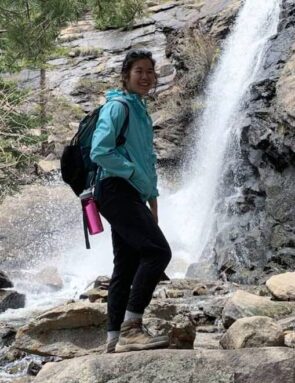
There’s a certain kind of quiet and peace I only find on a trail. Not silence – but a quiet that feels like my internal world finally matches the external one.
I’ve often wondered whether the reason I’m drawn so strongly to long hikes and physically demanding trails has something to do with how my brain works. Hiking doesn’t just feel like exercise to me. It feels regulating.
The Sensory Reset & Social Simplicity
In daily life, there’s a constant background noise: Notifications. Traffic. Fluorescent lights. Conversations I have to decode. On a hike, that disappears. The sounds are predictable – wind, birds, footsteps, waves. The light is natural. My focus on a hike is simple: walk, eat, drink, rest (basic survival things).
For a nervous system like mine that feels overstimulated and overwhelming in cities/crowds, the trail can feel like relief. Not because it’s empty, but because it’s calm and easy to understand and connect. Prior to learning more about my nervous system, I thought it was just my social anxiety.
I had really bad social anxiety around and after the pandemic, which triggered childhood wounds – when I had to sit in classrooms where the other kids thought I was the “weird, quiet, Asian girl” (it was probably just how I felt). Teachers were making fun of me. School didn’t feel like a safe environment and it was always so hard. I remember at age 7-9, I would come home from school and go straight to my pillow and nap for 3 hours. I thought that was “normal” like I’m the “easy child”, but I was recently told that that’s a “dysregulated child”. When I heard that, I thought about the sensory load and the mental load of how to act socially.
I would say I develop my social skills a bit later around age 10, when I started playing basketball and met my group of people. Growing up, it took a long time to finally feel safe within myself in order to feel safe around people. I’m a huge believer that all triggers throughout adulthood happen for a reason and are a guide to healing and finding peace within.
On a trail, I didn’t have to pretend to be anyone. Social rules become simpler – a nod, a “morning”, and shared understanding of effort. There is less small talk. Less decoding tone and facial expression. Less performance. This is also why I enjoy solo hiking. I’ve written more about solo hiking and headspace in my reflections on hiking the Three Capes Track.
It has nothing to do with disliking people. I appreciate human connections and believe that meaningful conversations with a stranger may teach you something about yourself. After gradually overcoming social anxiety, I find that a trail still offers the sensory reset.
Hyperfocus & Intensity
When I decide to hike, I don’t half-decide. I commit fully. There’s a kind of hyperfocus that kicks in – the same one that makes me prepare and train. I often go from 0-100. On trail, that intensity can be a strength. I can lock in and keep moving for hours. Neurodivergent energy can swing between all in and completely depleted. A multi day hike has a good rhythm. It’s immersive. It’s consuming. It gives my brain something big enough to hold onto.
The Structure – Freedom Paradox
I crave freedom (I think it’s a Sagittarius thing), but I function best with structure. A hike gives both. There’s a clear start and finish. Campsites are predetermined. Distance is measurable. Yet within that structure, there’s complete autonomy: No emails, no meetings, no expectations. That balance can feel stabilising.
Minimalism and Mental Load
City travel overwhelms me (more so before than now because I have self-regulation coping skills now). Airports. Boarding passes. Hotel check-ins. Keeping track of everything.
I’ve lost things more times than I’d like to admit – passport, ID, wallets. The mental load is constant. I don’t want to blame it on my ADHD. My ADHD coach said, “ADHD or neurodivergence is a reason, not an excuse”.
Traveling in cities feels like juggling glass. Overnight hiking feels like the opposite. When I hike, I know exactly what I carry. Everything has a place. Everything has a purpose. Tent, water, food, first aid, clothes, cooking items. That’s it. There’s something deeply regulating about that level of clarity.
Minimalism on trail reduces cognitive load. It removes background anxiety of misplacing something important because there are fewer things to track. When I’m hiking, my world shrinks to what I can carry. And instead of feeling restricted, I feel lighter.
The Shadow Side
Impulsivity can lead to booking things before fully thinking – I have signed up for marathons that I wasn’t fully sure about and end up having to cancel due to circumstances. Not because I was unready though – I did run 7 marathons without being fully ready.
Impulsivity can lead to underestimating weather or terrain and pushing harder than necessary. I had once put myself in a life-death situation where I was stuck on a mountain for 16hours in the cold, windy, rainy night alone. I had 1 emergency blanket and a sleeping bag so I didn’t get hypothermia. This is an example that my hyperfixation and intensity can negatively impact my life as well. I had been told so many times that I’m irresponsible. On the outside, I may appear as playful, irresponsible, adrenaline-seeking/risk-taking. Deep down, I knew I was seeking something and not simply just “running away from my problems”. Quite the opposite, I think. I was seeking the sensory reset and freedom from expectations in this society.
Post-hike Drop
After days of intensity and clarity, returning to normal life can feel flat or disorienting. The contrast is sharp. Understanding this pattern has helped me prepare better – not just physically, but emotionally. It’s not as intense as the post-marathon blues/depression but similar concept.
Why I keep coming Back
Hiking regulates me in a way very few environments do. It gives my body something real to respond to. It simplifies decisions. It quiets noise without numbing me. It doesn’t “fix” my nervous system – and I don’t want fixing. But it does create alignment with self.
Neurodivergence isn’t one experience. But many neurodivergent people describe feeling more regulated in natural environments.
Hiking can help because:
- Movement supports emotional regulation
- Natural sensory input is often less chaotic than urban environments.
- There are clear goals (distance, campsite, summit)
- Social interaction is optional and simplified
- The environment rewards focus and physical effort.
Like most things, it depends on the individual. For me, hiking feels like structured freedom – intense, grounding, and clarifying all at once.